
What's in a name?
The Unexpected Difficulty of Naming Yourself

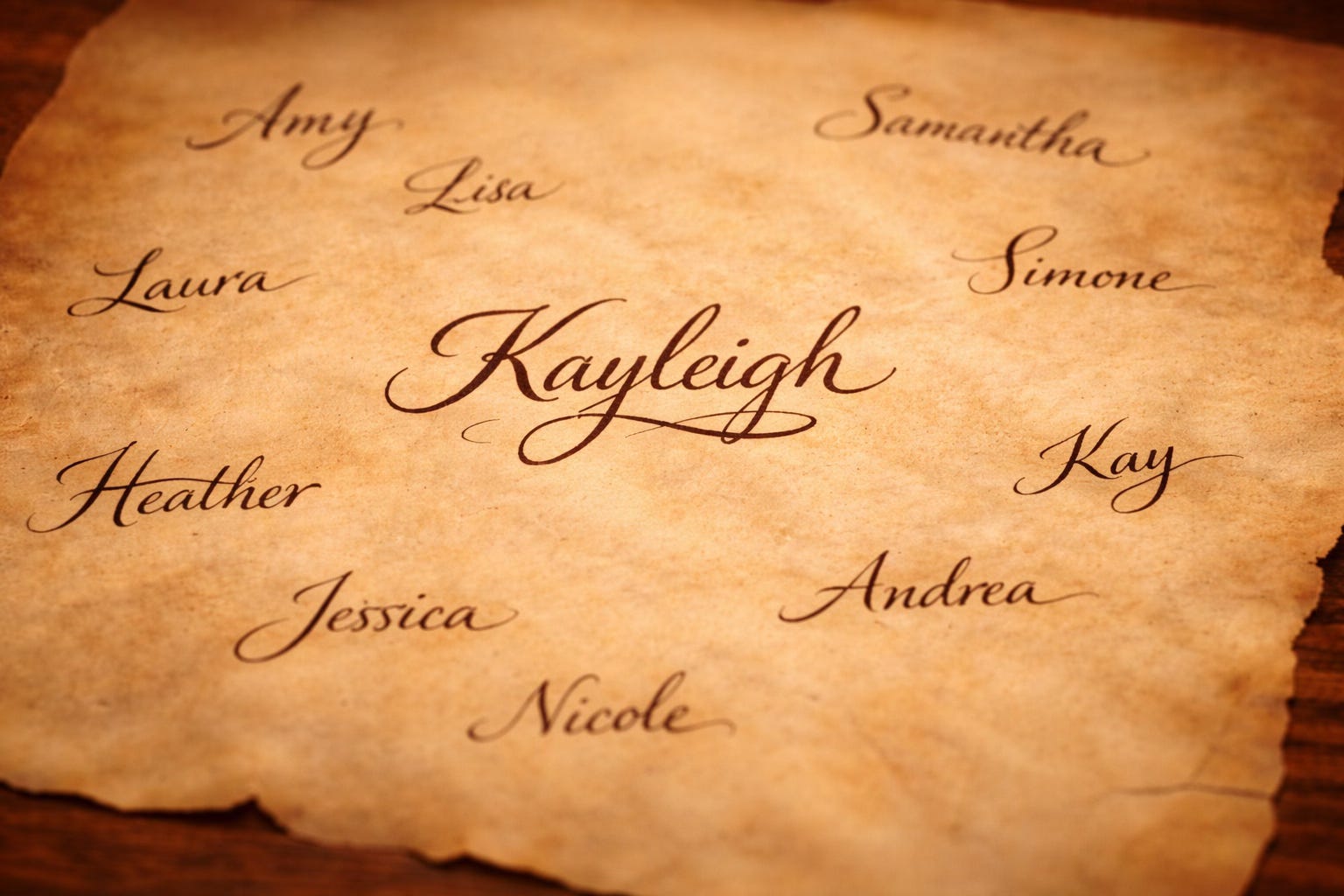
One of the first rites of passage when transitioning to living as your true gender is choosing a new name—one that reflects who you really are. Simple enough in theory. In practice, it’s an emotional obstacle course paved with second-guessing, overthinking, and the sudden realization that names are way more loaded than one might realize.
I remember when I joined Tri-Ess (The Society of the Second Self) in Florida back in the 90s. At my first gathering the very first question I was asked was:
“What would you like to be called?”
I froze like a deer-in-headlights, not quite sure how to respond.
Amy? Nah.
Samantha? Do I even look like a Samantha?
Laura? Absolutely not. My ex-girlfriend’s name was Laura, and she was nuts.
Heather?
Hmm.
Okay… Heather. Let’s go with that!
And just like that, I was Heather.
For a few months, at least.
I didn’t know any other Heathers personally, and I always thought the name had a timeless, feminine elegance to it. It felt safe. Respectable.
So Heather it was.
Until it wasn’t.
After a while, doubt started creeping in. Sure, I loved the movie Heathers, but I had very little in common with its titular characters—none of whom I would describe as role models for emotional stability. The name started to feel less like me and more like it belonged to a sorority sister with a minor in passive aggression.
Okay. Back to square one.
This time, I approached the process more methodically. I wanted something that echoed my birth name, but was unmistakably feminine. And since my given name was already somewhat unusual, I didn’t want to trade it for something overly common.
That’s when I remembered the 1985 song “Kayleigh” by the British band Marillion—a haunting, beautiful song about lost love. The name had stuck with me for years. It was unique. It sounded like me. It felt like me.
So I became Kayleigh.
Until it wasn’t.
What followed was what I now refer to as my hibernation period: two and a half decades of denial, repression, and dissociation. My female clothing, makeup, wigs, and breast forms were all discarded. And along with them, Kayleigh quietly slipped away too.
Until she didn’t.
A little over four months ago, my gender dysphoria resurfaced with a vengeance—gasping for air, clawing its way back to the surface, absolutely determined not to be buried again. If you haven’t read that story yet, it’s in Transitioning (Part 1)
And just like that, Kayleigh was back.
I was her.
Or was I?
One of the strange side effects of transitioning is the powerful urge to erase the life that came before. Clothes get donated. Social media accounts are purged. And previous legal names become known as a deadname—a term that sounds more like a Marvel Comics character than something related to gender transition.
But legal name changes are challenging to say the least. It’s not just one form—it’s dozens. Birth certificates, passports, bank accounts, credit cards, insurance policies, medical records… basically every institution you’ve ever interacted with.
Which got me thinking:
What if I didn’t change my legal name at all?
For those who don’t know, the name my parents gave me at birth is Kays. It comes from an old Arab legend about the 7th-century poet Qays ibn al-Mulawwah and his beloved Layla—a tragic love story so powerful it became the Middle Eastern equivalent of Romeo and Juliet. (More here if you’re interested: Layla and Majnun )
Traditionally in the Arab world, it’s a male name.
But does it have to be?
After all, in Italy, names like Andrea and Simone are exclusively male, while in English-speaking countries they’re commonly female. Turns out that names, just like gender, can be surprisingly fluid.
So why not stick with Kays?
Some of you might now be thinking: how about Kay?
I tried it for a bit on this very blog and I’m not quite feeling it.
Also—and I mean no offense whatsoever to any actual Kay’s reading this—but years of exposure to Mary Kay Cosmetics, Kay Jewelers, and Kay Bee Toys have left the name feeling less like an identity and more like a brand loyalty program.
So that leaves me with two choices:
Stick with Kays legally, embracing its gender neutrality and saving myself a mountain of bureaucratic misery…
Or fully commit to Kayleigh—the name that has lived in my heart for decades, waiting patiently for her turn.
For the time being, I’ve decided on a hybrid approach.
To my friends, coworkers, and in all social settings, I am Kayleigh.
But legally, I remain Kays—for now.
It’s practical. It’s flexible. And it gives me the space to grow into myself without the added stress of a courthouse waiting room that smells like despair and burnt coffee.
Besides, one of the most beautiful aspects of transitioning is that nothing has to be carved in stone.
Identity is a living thing.
And tomorrow… I might feel differently.
If this story resonated with you, I hope you’ll stick around. Consider subscribing, sharing this with someone who might connect with it, and following along as I continue navigating this strange, beautiful, occasionally ridiculous process of becoming myself. There’s a lot more to come.